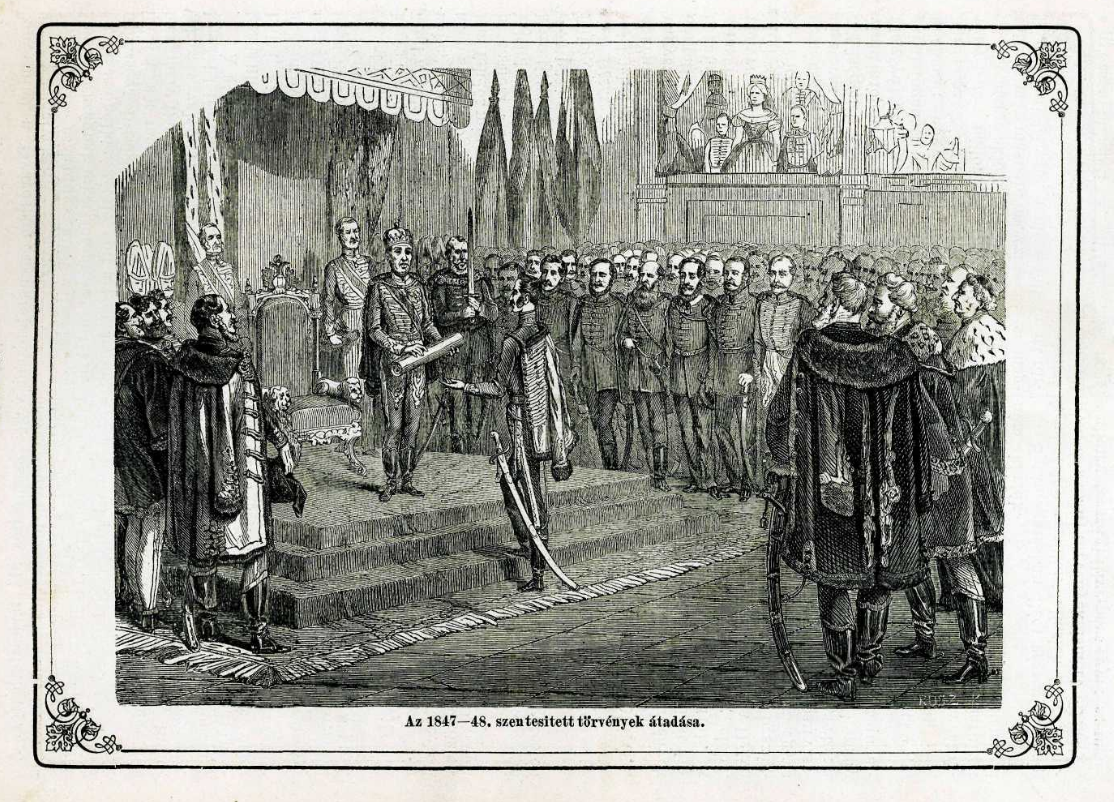
And we arrived to the events which led to his tragic faith. He was a natural pick for the position of the Prime Minister in the first independent and responsible government. The King Ferdinand sanctified his appointment and Batthyány formed his government, and sent the list for approval. But the Court was hesitant to separate the ministry of finance and war causing controversy and delay. Finally the appointments arrived, and the constitutional assembly also did it's job, so by 1848 April 11th the new government and the basic laws were ready. The national assembly and the independent government, responsible to the assembly moved to Pest-Buda from Pozsony. The case of Croatia and her ban, Jelacic became a thorn they couldn't pluck out. In previous post I wrote about the case >>/16937/. His disobedience and the invasion and the situation around legality toppled the government, ministers resigned, Batthyány left alone at the helm. He attempted to form a new government, but even the nádor (the representative of the King as the Head of State) fled the country for he couldn't pick between his responsibility towards the country and loyalty to his King and family. The reactionary clique in the Court worked with all their influence. The nádor resigned, new Prime Minister was appointed, and a military governor to boot, in the person of Count Lamberg Ferenc. Him Batthyány knew and hoped he could agree on stopping Jelacic, so he went to seek him out in his camp. Meanwhile Count Lamberg himself went to a meeting at Pest, and while crossing the bridge a group of angry Hungarians stopped his coach, and murdered him on September 28th. Events spiraled out, Batthyány resigned on October 2nd and joined the army to fight as a simple soldier. However due to an incident he fell of his horse and broke his arm. While healing from the injury he was asked to return to politics. He became a member of the Parliament, then sought out Windisch-Grätz with a delegation, trying to negotiate. After this failed he remained at Pest where he was arrested after the army of the Court entered the city, on January 13th, 1849. He ceased to be a public figure and the shaper of the events.
 10/06/2025 (Mon) 16:33
No.54725
del
10/06/2025 (Mon) 16:33
No.54725
del