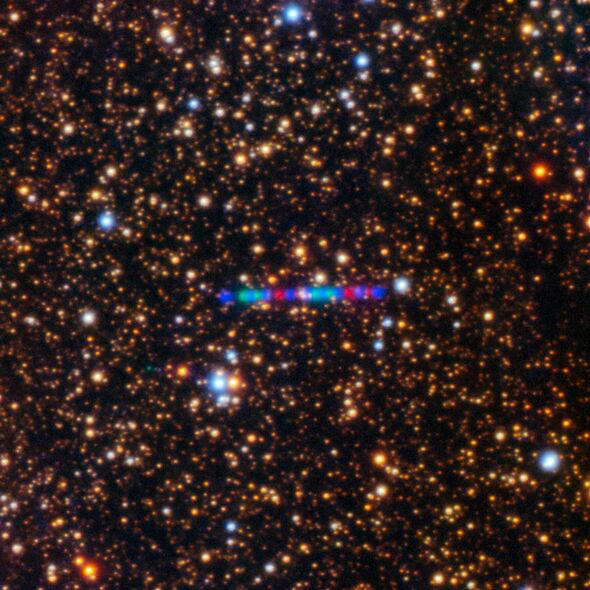
The Challenge of Obtaining Resolved Images of Interstellar Objects August 19, 2025
Given its trajectory, the nucleus of the new interstellar object, 3I/ATLAS, cannot be resolved from Earth or space with our existing telescopes. If the nucleus is 10 kilometer in diameter, then its angular size would be about 10 milli-arcsecond at closest approach to Earth from a distance of about twice the Earth-Sun separation.
However, if NASA will choose to construct an optical interferometer on the Moon during its Artemis program, then we will be able to obtain resolved images of the nuclei of interstellar objects like 3I/ATLAS. The existing facilities of optical interferometry on Earth can only detect stars much brighter than 3I/ATLAS because of the limit imposed on their exposure time by atmospheric turbulence.
An interferometer on the Moon would avoid the phase shifts caused by atmospheric turbulence on Earth. With a baseline of several hundred meters and 1-meter mirrors operating at visible wavelengths, such a facility would reach the angular resolution and flux sensitivity needed to resolve the nucleus of 3I/ATLAS or similar interstellar objects in the future.
The recently inaugurated NSF-DOE Rubin Observatory in Chile is expected to discover a new interstellar object every few months, making a Lunar interferometer with these capabilities extremely useful in identifying the nature of these objects by imaging them. A resolved image can immediately inform us of whether an interstellar object is a natural rock of rank-0 or a technological spacecraft of rank-10 on the Loeb Scale.
High-resolution imaging can also be obtained from a camera that flies close to an interstellar object. For 3I/ATLAS, I proposed using the camera on Juno spacecraft, currently in orbit around Jupiter. If Juno had its initial fuel reservoir available, it could have intercepted the path of 3I/ATLAS when this object arrives closest to Jupiter on March 16, 2026.