New Images of Nickel and Cyanide Around 3I/ATLAS from the Keck Telescope (and other 3I Atlas updates) October 15, 2025
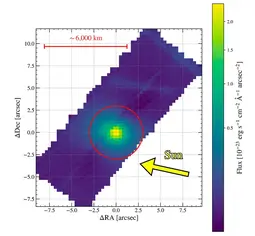
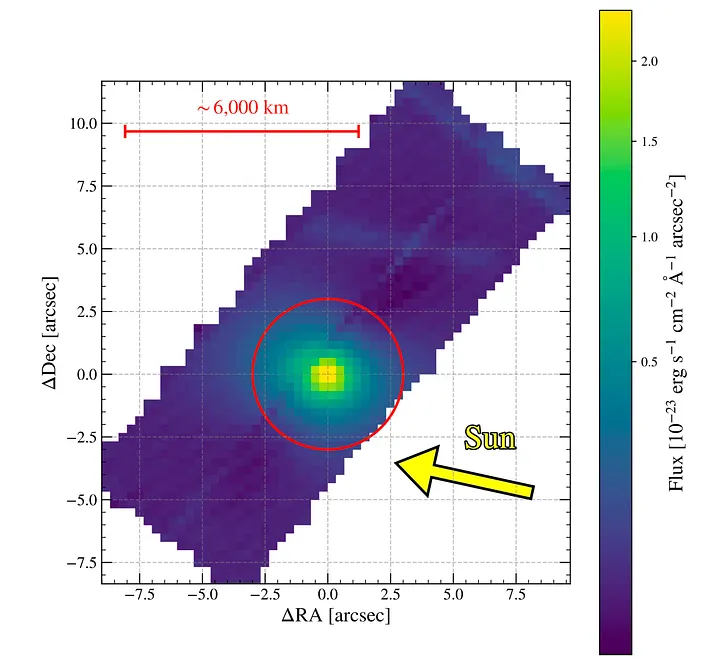
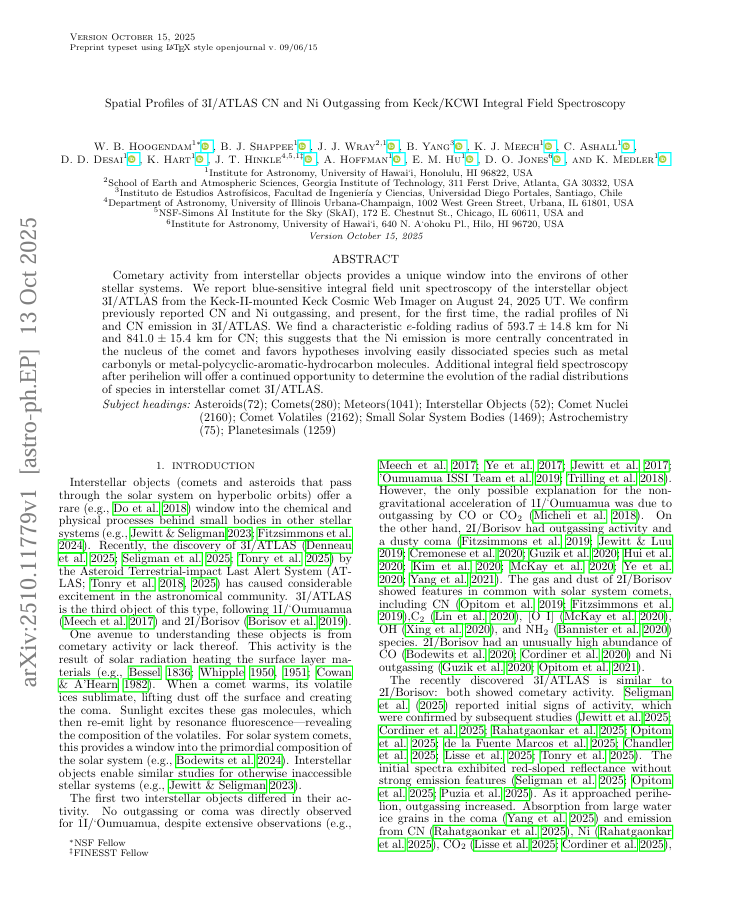
A new paper on the interstellar object 3I/ATLAS (accessible here), reports data taken by the Keck II telescope in Hawaii on August 24, 2025, when 3I/ATLAS was at distances of 2.75 and 2.6 times the Earth-Sun separation (AU) from the Sun and Earth, respectively. As with the Hubble Space Telescope image obtained on July 21, 2025 (analyzed here and here), the image taken by the Keck Cosmic Web Imager (KCWI) in the wavelength range of 0.3425 to 0.55 micrometers shows evidence for a puzzling anti-tail extension in the direction of the Sun.
In contrast from all known comets, including the interstellar comet 2I/Borisov, the observed spectrum of the gas plume around 3I/ATLAS shows prominent nickel emission but no evidence for iron. Other than 3I/ATLAS, this anomaly was only known to exist in industrially-produced nickel alloys through the carbonyl chemical pathway, which refines nickel through the formation and decomposition of nickel tetracarbonyl, Ni(CO)4. The authors of the new paper postulate that this carbonyl process is realized naturally near the nucleus of 3I/ATLAS. They argue that “this in-situ formation of Ni(CO)4 predicts that nickel should be strongly concentrated near the nucleus”.
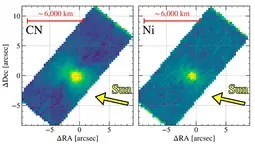
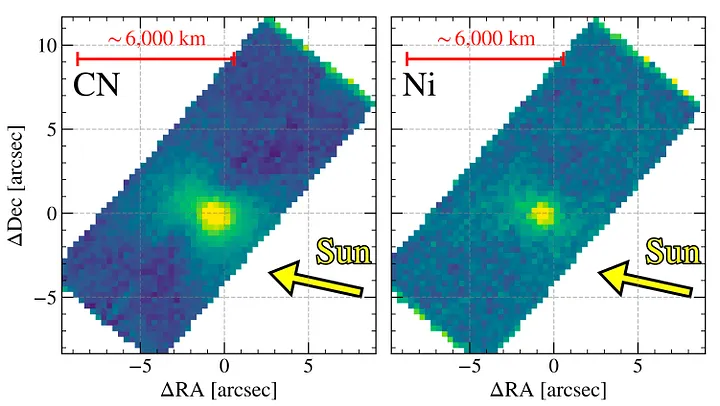
A narrow-band KCWI image of 3I/ATLAS in nickel (Ni) and cyanide (CN) emission at the wavelength ranges of 0.3865–0.3885 and 0.3605–0.3625 micrometers respectively, shows a central concentration of nickel relative to cyanide. The emissions by the surrounding gas plume extends out to an exponential radius of 600 kilometers for nickel and 840 kilometers for cyanide.
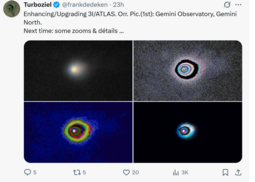
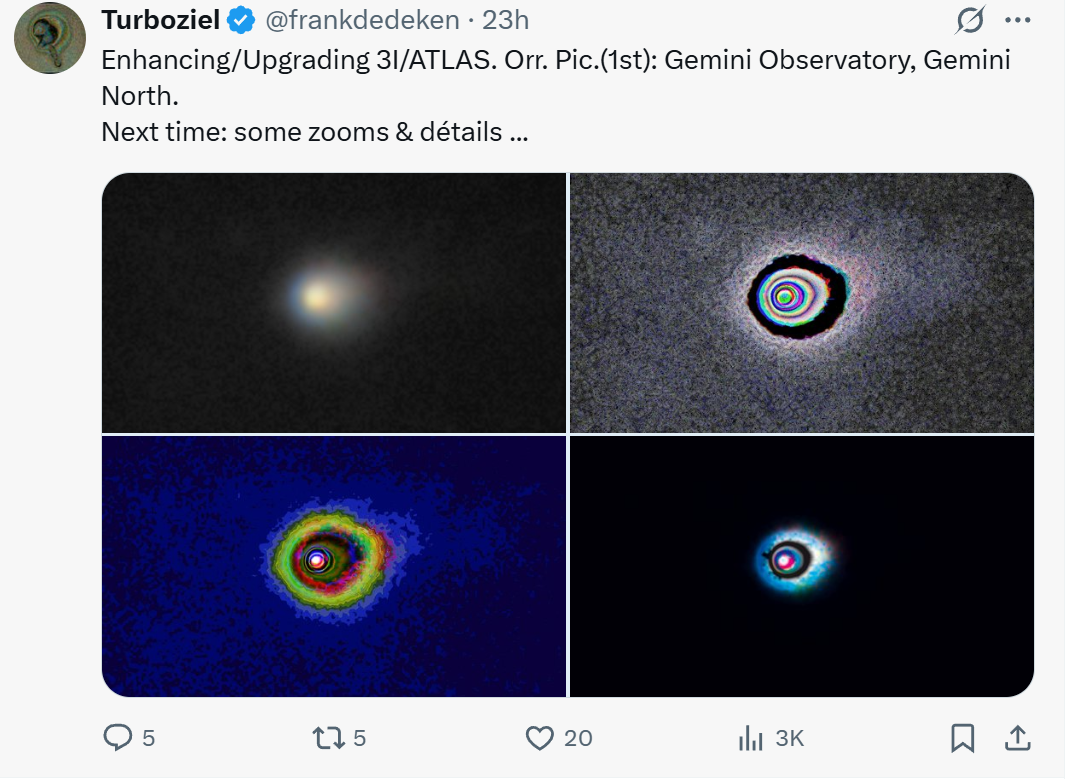
In describing another anomaly, the authors state that “the production rate of nickel relative to cyanide is higher than in 2I/Borisov and orders of magnitude above the solar system comet median.” The emission profiles of both nickel and cyanide around 3I/ATLAS are asymmetric with extension in the solar and anti-solar directions, offering clear evidence for an anti-tail. Most remarkably, the white light image of 3I/ATLAS does not show evidence for a familiar cometary tail, as expected for dust which scatters sunlight and is pushed away from the Sun by solar radiation pressure.