First Peer-Reviewed Study Finds Direct Molecular Evidence of mRNA “Vaccine” Genomic Integration
Immediate market withdrawal and full accountability are now imperative. Oct 15, 2025
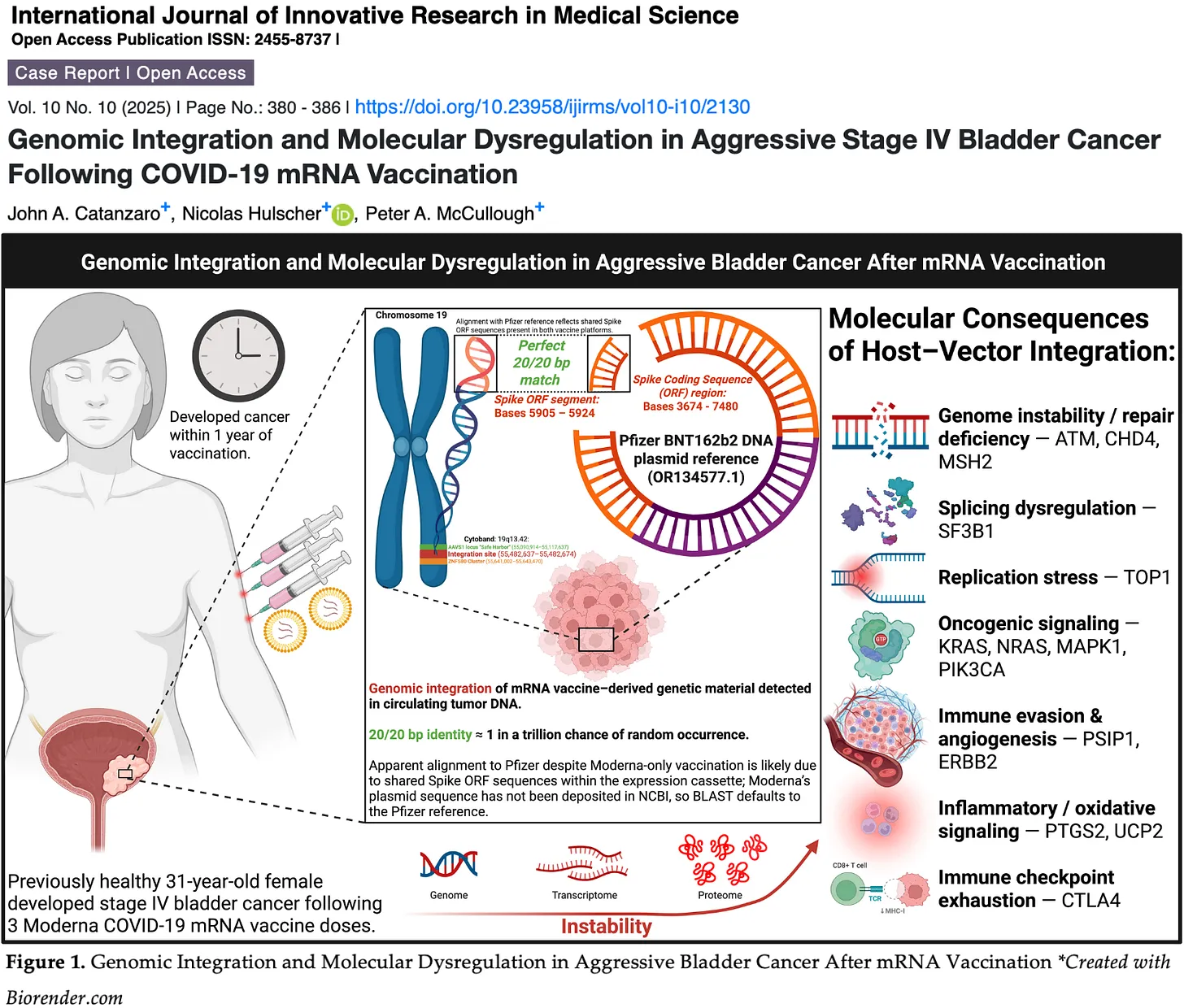
In a Stage IV cancer patient, we identified a vaccine-derived Spike gene sequence chimerically fused into chromosome 19 with perfect 20/20 base-pair identity — a 1-in-a-trillion chance of coincidence.
In our sentinel peer-reviewed case report, Genomic Integration and Molecular Dysregulation in Aggressive Stage IV Bladder Cancer Following COVID-19 mRNA Vaccination—published in the International Journal of Innovative Research in Medical Science (John A. Catanzaro, Nicolas Hulscher, and Peter A. McCullough; a Neo7Bioscience–McCullough Foundation collaboration)—we describe a previously healthy 31-year-old woman who developed rapidly progressive stage IV bladder cancer within 12 months of completing a three-dose Moderna mRNA injection series.
Bladder cancer is exceedingly rare in young women, and such aggressive presentations are almost unheard of.
To investigate, we performed comprehensive multi-omic profiling, including plasma-derived circulating tumor DNA, whole-blood RNA, and urine exosome proteomics. What we uncovered was striking:
Direct genomic integration event: Within circulating tumor DNA, a host–vector chimeric read mapped to chr19:55,482,637–55,482,674 (GRCh38), in cytoband 19q13.42, positioned ~367 kb downstream of the canonical AAVS1 safe harbor and ~158 kb upstream of ZNF580 at the proximal edge of the zinc-finger (ZNF) gene cluster. This sequence aligned with perfect 20/20 bp identity to a segment (bases 5905–5924) within the Spike open reading frame (ORF) coding region (bases 3674–7480) of the Pfizer BNT162b2 DNA plasmid reference (GenBank accession OR134577.1).