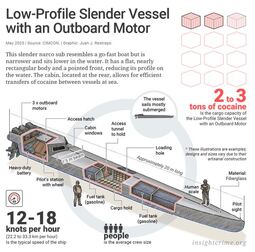
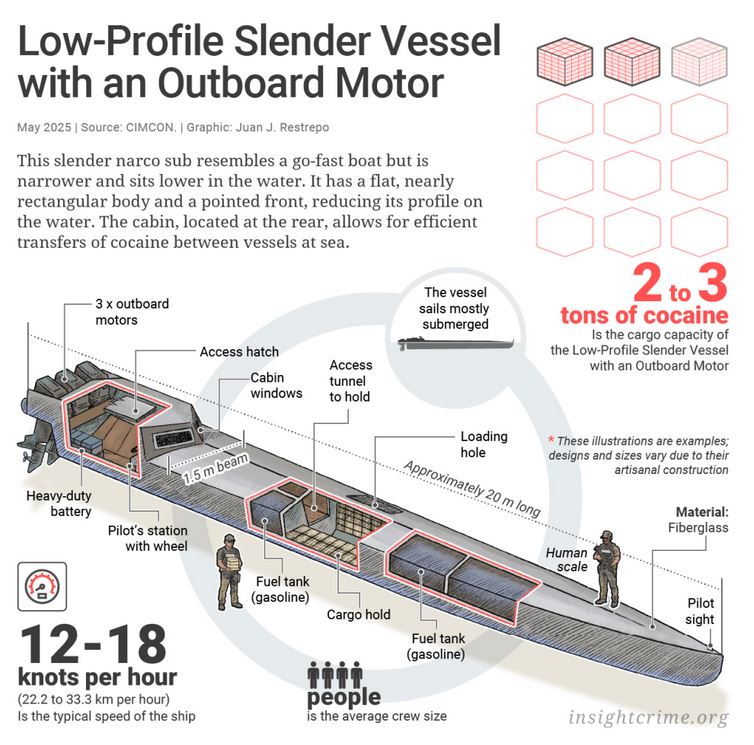
>>167019 Types of Vessels Most narco subs intercepted are not true submarines and cannot dive beneath the surface. Instead, they sit extremely low in the water, with only a small portion visible above the surface, making them difficult to detect. Authorities commonly refer to this vessel type as a Low-Profile Vessel (LPV). A typical LPV is around 15 meters long, with a slender, elongated shape. It features a diesel or gas engine and is built primarily from wood and fiberglass, materials that are tricky to spot using radar. The cockpit and exhaust tubes stay above water, while most of the vessel remains underwater. There are several variations, and traffickers regularly adapt their designs in response to interdiction efforts and the availability of parts or skilled labor. For example, after law enforcement began using thermal imaging cameras to spot narco subs, some traffickers employed devices like lead shields and heat exchangers designed to obscure the subs’ heat signal. Around 2016, many traffickers switched from using inboard to outboard motors, which are easier to install and more readily available in the remote locations where most subs are built. The vessels are also camouflaged in paint picked to match the ocean where they sail and the climatic conditions expected during the voyage. Subs traversing shallow waters in the Pacific tend to be teal, for example, while those crossing the stormy Atlantic tend to be painted in dark blue or gray hues. LPVs can cost as little as $150,000 to build, according to the Colombian Navy’s International Center for Research and Analysis Against Maritime Drug Trafficking (Centro Internacional de Investigación y Análisis Contra el Narcotráfico Marítimo – CIMCON), although most estimates place the cost between $1 million to $2 million. They typically require three or four pilots for their voyages. While low-profile vessels run a greater risk of interception because they operate at the surface of the ocean, they also require less skilled labor to construct and operate than a fully submersible vessel. Their low profile means they create a small silhouette, making them tricky to spot from the sea, and their hydrodynamic shape leaves little wake, making them hard to identify from the air. Fully Submersible Vessels (FSVs) are the most sophisticated type of narco sub, capable of diving completely underwater, often up to about 30 feet below the surface. They can transport up to 10 tons of cocaine, are invisible to radar, and are equipped with advanced GPS and navigation systems. Building an FSV is an enormous undertaking. Construction requires expert engineering skills and large investments ranging from $2 million to $4 million, according to CIMCON. But the large costs pay dividends for the traffickers. FSVs have only been discovered on land, suggesting that once they are out to sea, they are almost impossible to detect. The only FSV caught while actually delivering a drug shipment was seized in Venezuela in 2022. The submarine was traveling inland, along the Arauca River, suggesting that it was used to transport cocaine from Colombia to Venezuela, avoiding detection from criminal groups and authorities in an unsafe border area. cont...